NiCd batteries (Nickel-cadmium)
Elfa's experts are ready to answer any questions and provide further assistance.
.png)


The first nickel-cadmium battery was invented by Waldemar Jungner in 1899, when lead-acid batteries were the only direct competitor that were physically and chemically robust. Jungner’s design offered several advantages over the lead-acid battery, but the materials were expensive and its use was limited. In 1932, active materials were deposited in a porous, nickel-plated electrode. Fourteen years later, the first production in the US began in 1946.
Key benefits of NiCd batteries
- Robust and reliable: NiCd batteries can withstand heavy use and perform stably in demanding environments
- Ultra-fast charging: quick to charge with minimal stress on the cells, making them suitable for intensive use
- Long shelf life: can be stored in a discharged state without problems
- Easy storage and transport: not sensitive to storage conditions, making them practical in logistics
- Strong at low temperatures: continue to function well where other chemistries fail more quickly
- Economical per cycle: often the lowest cost per charge cycle
- Many sizes and designs: available in a range of formats and performance options
- Customization possible at Elfa: we can assemble custom NiCd custom battery packs for your application.
Memory effect Nickel-cadmium batteries
The standard NiCd battery requires proper use to achieve a long lifespan. NiCd batteries can suffer from the so-called memory effect when they are repeatedly discharged and recharged to the same level. As a result, the battery appears to “remember” how much energy is usually required and may deliver less capacity over time.
This effect can be limited by regularly fully discharging the battery and then fully charging it again.
Nickel-cadmium batteries partially banned
As of 1 January 2017, the sale of portable NiCd batteries has been banned in Europe for small applications, such as cordless power tools. The previous exception for this expired on 31 December 2016.
The reason for this ban is that NiCd batteries contain highly toxic cadmium. This is harmful to both people and the environment, making proper collection and recycling especially important.
There are still exceptions for certain applications in which NiCd batteries may be sold, such as:
- Medical applications
- Safety and emergency systems (including alarms and emergency lighting)
- Industrial and professional use
Please note: EU battery regulations have been further tightened since 2023 and replaced by a new Battery Regulation. However, the dates and exceptions above specifically refer to the ban on NiCd batteries in portable consumer applications introduced in 2017.
Disadvantages of NiCd batteries
- Relatively low specific energy compared to newer systems
- Memory effect: needs periodic full discharges
- Cadmium is a toxic metal: cannot be disposed of in landfills
- High self-discharge: must be charged after storage
Example of a NiCd battery
Elfa offers various NiCd batteries that may be of interest to you, such as Arts Energy NiCd batteries, including the ArtsEnergy VNT DU NiCd pack 2.4 V 4 Ah SBS Faston straight. This rechargeable NiCd battery pack from Arts Energy is specially tailored for Elfa customers.
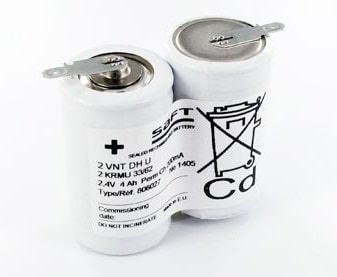
This battery pack is characterized by its compactness and robustness. Arts Energy’s strategy focuses on a range of diverse technologies, product connectivity, and customized solutions, which are central to their approach.
NiMH batteries, a potential alternative
When you are looking for an alternative to NiCd batteries, NiMH batteries can be an interesting option. For example, NiMH batteries have a 30–40% higher capacity than NiCd batteries. NiMH batteries also suffer significantly less from the memory effect and are more environmentally friendly because they do not contain toxic materials. Finally, NiMH batteries have a lower self-discharge than NiCd batteries.

At Elfa, we also offer NiMH batteries from various brands, such as the NiMH rechargeable D-batteries from VARTA mentioned above, with a voltage of 1.2 V and a capacity of 3 Ah. These batteries are known for their efficiency, durability, and high-quality materials. The VARTA brand originates from Germany and is one of the leading battery manufacturers worldwide.