Working safely with the right lighting
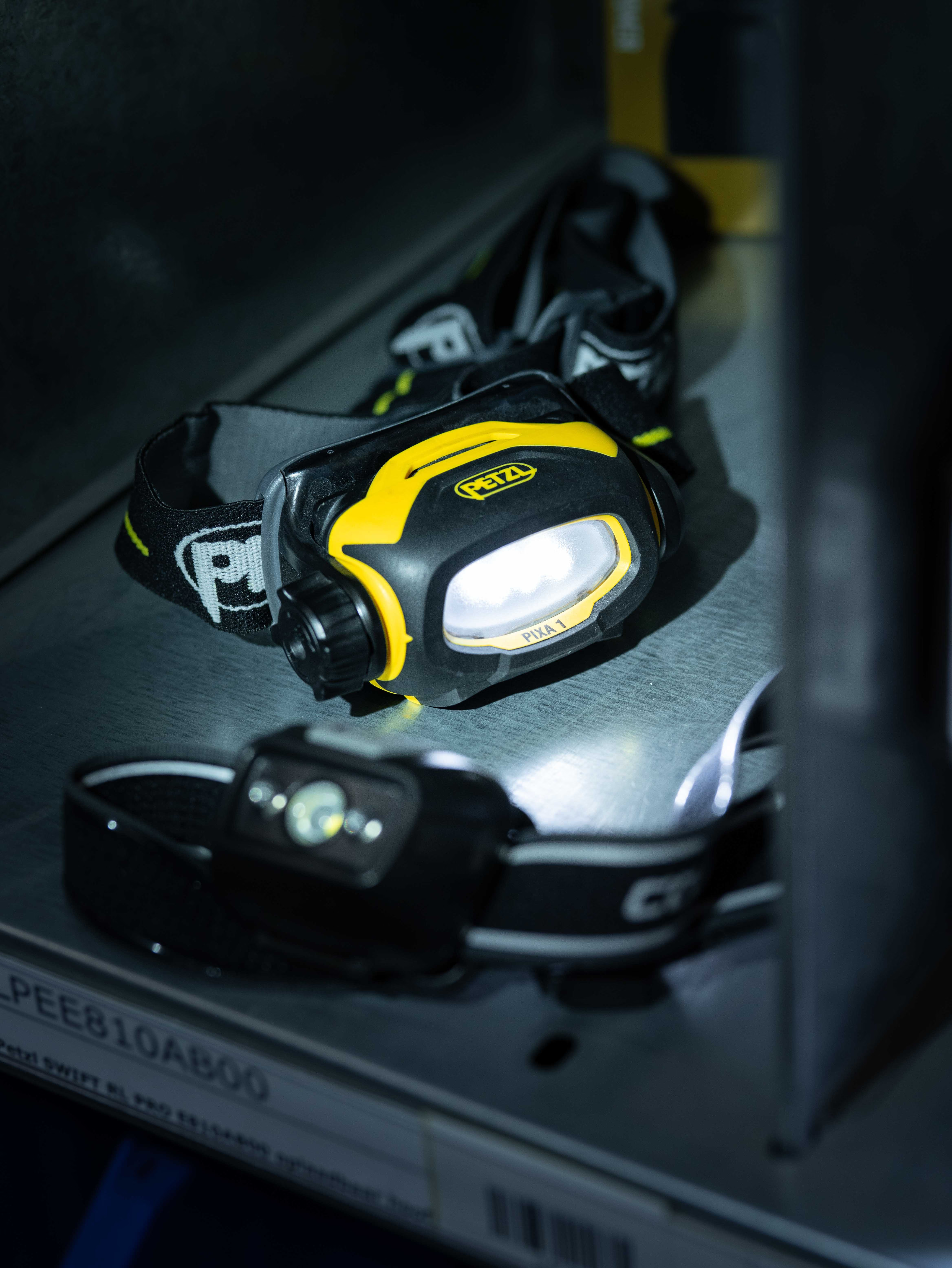
Elfa offers a professional range of mobile and fixed lighting solutions for a wide variety of working environments. Our range includes personal lighting such as flashlights and headlamps, as well as work lighting and specialist applications such as ATEX-certified lighting. Proper lighting is essential for safe and efficient working and forms the foundation of reliable lighting advice.
For every type of lighting
.png)
Work lighting
Powerful and reliable lighting for construction, maintenance, and industrial applications, including LED floodlights, portable work lights, and 360-degree lighting solutions. Elfa offers a comprehensive range of professional LED work lights for use in sectors such as rail, construction, industry, and emergency services.
Where technology, expertise, and innovation come together
Daan, Sales Director
.svg)
Quality is our standard
We work exclusively with leading brands and certified components. Every product is thoroughly tested for performance and safety to ensure maximum reliability.
In-house assembly
Production takes place at our own facilities, in accordance with strict safety standards and procedures. This enables us to design and assemble complex battery packs.
Expert advice from our specialists
We support you throughout the entire process - from specification to implementation - ensuring that the chosen solution fully meets your technical requirements.

Frequently asked questions

An ATEX-certified lamp can be identified by the certification markings printed on the lamp housing. These ATEX codes indicate the level of explosion protection and the environments in which the lamp may be safely used.
Common ATEX markings and their meanings
- CE — Confirms that the product complies with European regulations and quality requirements
- Ex — Indicates explosion protection certification
- G / D / GD — Suitable for gas atmospheres (G), dust atmospheres (D), or both (GD)
- EEx / Ex — Approved for use in explosive environments according to European standards
- e / d / i / n — Indicates the protection method used
- IIA / IIB / IIC — Gas group classification, where IIC represents the highest explosion risk
- T1 to T6 — Temperature classification based on maximum surface temperature, where T6 has the lowest surface temperature and highest safety level
ATEX certification must be issued by a notified certification body such as KEMA or DEMKO.
If a lamp is tested by a non-certified inspection body, certification is generally limited to Zone 2 applications, which represents the lowest explosion protection category.
For more information about ATEX regulations and certified lighting solutions, please visit our ATEX information page.
Lumens (lm) indicate the total amount of light a lamp produces. It measures the overall light output of the light source, regardless of the environment or distance. A lamp always emits the same number of lumens.
The amount of lumens required depends on factors such as the size and height of the area that needs to be illuminated.
Lux (lx) indicates how much of that light actually reaches a specific surface or area. Lux is measured per square meter and therefore depends on distance, beam angle, and surroundings.
For example: a 10-lumen lamp may illuminate a small cabinet sufficiently, but on a large construction site the lux value becomes too low to provide useful lighting at greater distances.
ATEX is mandatory European legislation for equipment used in explosive atmospheres within the EU, while IECEx is an international voluntary certification system accepted worldwide.
Both systems are based on IEC standards and demonstrate compliance for equipment used in hazardous environments. The main difference is that ATEX applies specifically within the European Union, whereas IECEx is internationally recognized.
Read more about ATEX and explosion-proof equipment here.
LED stands for Light Emitting Diode and is considered the lighting technology of today and the future.
Unlike traditional incandescent lamps, LEDs do not use a fragile filament. Instead, they convert electrical energy directly into light, making them far more energy-efficient and durable.
Advantages of LED lighting
- Very energy efficient: high light output with low power consumption
- Extremely long lifespan (approximately 20,000 to 100,000 operating hours)
- Resistant to shocks and vibrations because no filament is used
- Suitable for varying temperatures
- Flexible light control using lenses and beam shaping
Possible disadvantages of older LED technology
- Older LED lamps could produce a relatively cool or bluish light color
Modern LED technology now offers a wide range of color temperatures and lighting solutions for both professional and consumer applications.
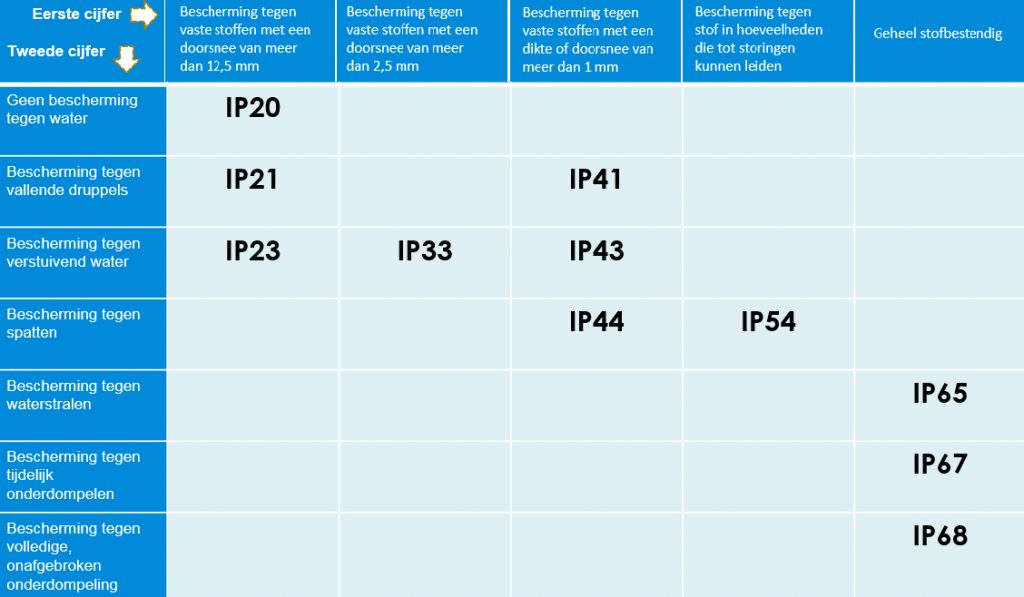
The IP encryption on electricaAn IP rating indicates how well an electrical device is protected against dust, dirt, and moisture in demanding environments.
IP ratings are internationally standardized according to the IEC 60529 standard and consist of two digits:
- The first digit indicates protection against solid objects and dust
- The second digit indicates protection against water and moisture
The higher the number, the greater the level of protection.
Below is an overview of commonly used IP ratings and their meanings.
l devices indicates the degree to which the device is protected against damage caused by use in hostile environments. See below for an overview of commonly used IP designations:
ATEX distinguishes different hazardous zones based on the presence of potentially explosive gas or dust atmospheres.
The classification depends on how often and how long an explosive atmosphere may occur in the work environment. These zones determine which equipment and safety systems may be used.
Gas explosion zones
(flammable gas, vapour, or mist mixed with air)
- Zone 0 — Explosive atmosphere is present continuously or for long periods
- Zone 1 — Explosive atmosphere may occur occasionally during normal operation
- Zone 2 — Explosive atmosphere occurs rarely and only for a short time
Dust explosion zones
(combustible dust clouds)
- Zone 20 — Explosive dust atmosphere is continuously present or present for long periods
- Zone 21 — Explosive dust atmosphere may occur occasionally during normal operation
- Zone 22 — Explosive dust atmosphere occurs rarely and only briefly
The lower the zone number, the higher the explosion risk and the stricter the safety requirements for the work environment, equipment, and protection systems.
For more information about ATEX regulations and certified equipment, please visit our ATEX information page.