Lead-acid batteries
Reliable and high-performance energy storage, delivering stable voltage and strong load capacity.
.png)


The lead-acid battery was invented as early as 1859. Despite its long history, it remains the most widely used rechargeable battery, thanks to its simple design, relatively low cost, and ability to deliver high currents and voltages.
Batteries for professional use
Lead-acid batteries are a type of rechargeable battery widely used in industrial applications. Using an electrolyte of sulfuric acid and lead compounds, these batteries deliver reliable performance, high current output, and a relatively long service life compared to some other battery types.
They are commonly used in applications that require high power, such as vehicles (including marine and aviation systems), as well as in electrical systems like backup power supplies and alarm installations.
Elfa supplies lead-acid batteries to the following sectors:
- Telecommunications
- Data centers
- Security systems
- Railways
- Defense
- Energy and distribution plants
- Smart grids
What types of lead-acid batteries are available?
At Elfa, we offer VRLA (Valve Regulated Lead-Acid) batteries, also known as SLA (Sealed Lead-Acid) batteries. This type of battery uses a fixed (immobilized) electrolyte. There are two main technologies for immobilizing the electrolyte: Gel and AGM (Absorbent Glass Mat).
Both variants feature a sealed housing with pressure-regulating valves, ensuring a maintenance-free, safe, and durable battery. However, Gel and AGM batteries differ in the way the electrolyte is contained and the type of separator used.
These battery types are available from leading brands such as FIAMM and Yuasa.
AGM battery
The AGM (Absorbent Glass Mat) battery is a technology in which the electrolyte is absorbed into a glass fiber separator. Because the electrolyte is immobilized, it does not need to be refilled. In addition, AGM batteries are sealed, leak-proof, and can be installed in various positions.
AGM batteries have a low internal resistance, allowing them to deliver high current when needed. They also perform well across a wide temperature range, have low self-discharge, and offer a long cycle life.
What are the benefits of an AGM battery?
- Low self-discharge
- Many cycles
- Completely maintenance-free
- Up to 80% unloading
- Can be mounted in any position (except upside down)
- Environmentally friendly due to recyclability
What are the disadvantages of an AGM battery?
- Performs poorly in heat
- Heavy
- FIAMM AGM lead batteries
This lead battery from FIAMM can perform at maximum performance in demanding applications. This includes UPS systems, emergency lighting and traction applications. By the way, the FIAMM battery can be deeply discharged if necessary. In addition, the battery is suitable for air, sea, rail and road transport (non-hazardous). Furthermore, the battery is 100% recyclable.

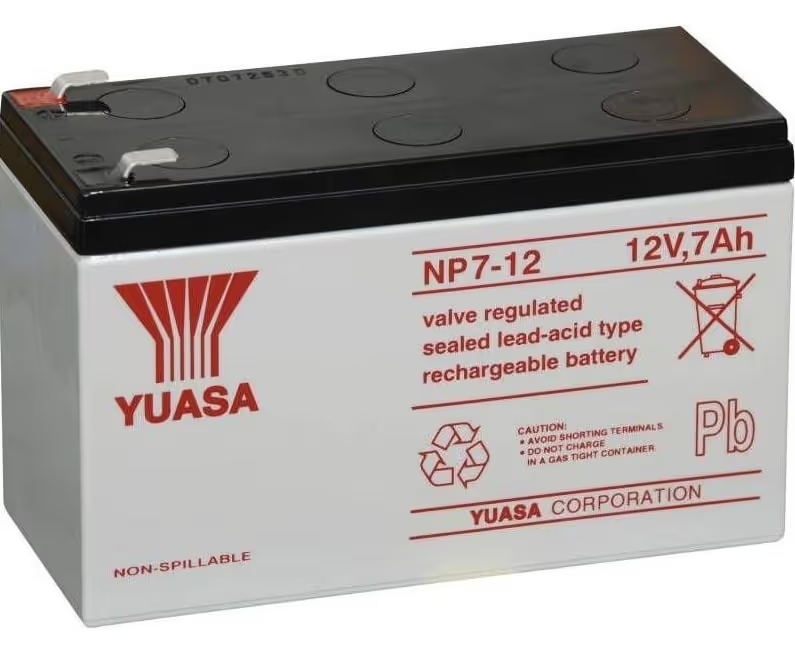
- Yuasa AGM lead acid battery
The Yuasa 12 V 7 Ah AGM battery is a high-quality, efficient, and environmentally conscious solution. Yuasa batteries have been manufactured in the United States since 1979. They are also known as powersports batteries.
Gel battery
The difference between AGM batteries and gel batteries is that gel batteries contain silicone compounds added to the battery acid. As a result, the electrolyte turns into a gel and the battery can no longer leak.
In these batteries, oxygen gas creates channels in the gel from the positive plate to the negative plate. In this way, it comes into contact with hydrogen gas and is recombined into water.
Gel batteries have an excellent capacity and are very resistant to deep discharge.
What are the benefits of gel batteries?
- Relatively low price;
- Low self-discharge;
- Deep discharge possible;
- Lots of cycles;
- Maintenance-free and closed;
- Environmentally friendly due to recyclability.
What are the disadvantages of gel batteries?
- Sets charger requirements;
- Adjust charging voltage at high temperatures;
- Has slight excess pressure internally;
- Sensitive to deep discharge.
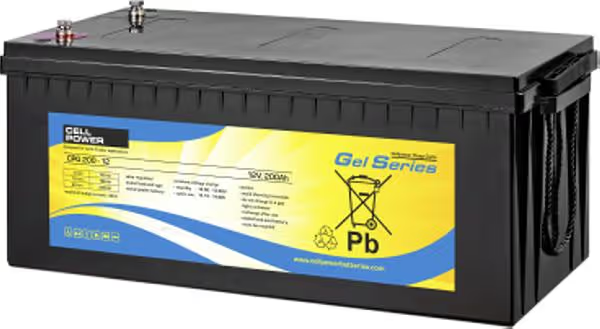
- Cellpower lead battery
The Cellpower CPG200‑12 is a 12 V 200 Ah deep-cycle gel lead-acid battery designed for professional and cyclic use. Thanks to the gel electrolyte, the battery is completely maintenance-free, leak-proof, and safe to install in various positions. With a robust construction, M8 screw terminals, and an operating temperature range of −20 °C to +50 °C, this battery is suitable for applications such as electric vehicles, mobility scooters, golf carts, motorhomes, marine systems, and energy storage.
The battery can be deeply discharged at regular intervals and delivers thousands of cycles at a 50% depth of discharge. With high charge and discharge capacity, low self-discharge (< 3% per month), and reliable gel technology, the CPG200-12 offers long life and consistent performance.
What is an important difference between gel and AGM?
Both AGM and gel batteries are so-called recombination batteries. This battery type has a number of advantages over other variants. For example, if a recombination battery is damaged, no battery acid can be released.
Elfa observes that the terms AGM and gel are sometimes used carelessly and interchangeably. AGM batteries, which only came onto the market twenty years after gel batteries, are sometimes mistakenly referred to as gel batteries. This can lead to issues with the safe and long-term functioning of the batteries.
This is because AGM and gel batteries have very different requirements in terms of charging voltage and temperature. Our specialists are happy to advise you in making the right choice for your application