Sodium-ion saltwater battery
A maintenance-free and safe battery, ideally suited for solar energy storage systems.
.png)


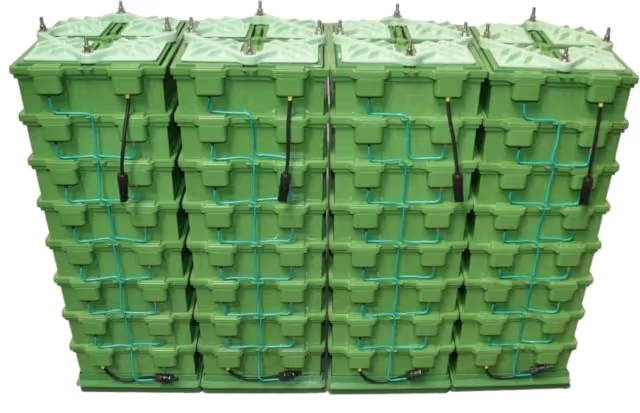
The sodium-ion saltwater battery is the world’s first truly safe and sustainable battery, ideally suited for solar energy storage systems. This sealed electrochemical energy storage system is based on a unique saltwater electrolyte.
The sodium-ion saltwater battery is the world’s first truly safe and sustainable battery, ideally suited for solar energy storage systems. This sealed electrochemical energy storage system is based on a unique saltwater electrolyte.
Saltwater batteries are maintenance-free and safe
Saltwater batteries are maintenance-free and designed for daily deep discharge. They are highly resilient, operate reliably across a wide temperature range, can be partially charged without degradation, and are easy to configure and install.

Sodium-ion saltwater batteries are optimized for daily deep discharge, with typical charge and discharge cycles ranging from 4 to 20 hours.
AIB™ saltwater batteries use a safe electrolyte based on saltwater. The batteries are fully sealed and maintenance-free. They are self-balancing, eliminating the need for equalization charging or a battery management system (BMS).
Benefits of saltwater batteries
Carefree
- Modular design: available in 12 V, 24 V, and 48 V nominal blocks for both low- and high-voltage configurations
- Easy integration: simple connection using standard connectors
- Maintenance-free: fully sealed construction
- System compatibility: compatible with all leading power conversion systems
- Safe transport: saltwater batteries can be shipped as non-hazardous goods
Robust performance
- Robust performance: reliable operation under demanding conditions
- Wide temperature range: operates from -5 °C to 50 °C without the need for heating, ventilation, or air conditioning (HVAC)
- Partial charge tolerance: withstands partial charge cycles without impacting battery life
- Long service life: up to 3,000 cycles under real operating conditions
- Deep discharge capability: supports 100% depth of discharge without affecting battery life
- Self-balancing: no equalization charging required
Peace of mind
- Non-flammable and non-explosive: no fire suppression systems required
- Sustainability certified: Cradle to Cradle Certified™ Bronze
- Long-term reliability: 10-year warranty
- Made in Austria: high European manufacturing standards
AIB chemistry
In addition to the safety and sustainability benefits of using saltwater as an electrolyte, another advantage is the thermal mass of the contained water. This means that AIB batteries do not heat up or cool down quickly, allowing them to operate reliably across a wide temperature range.
The AIB chemistry is based on charge and discharge mechanisms that are not affected by the state of charge. As a result, these batteries can be stored or operated for extended periods in a partial or even uncharged state without irreversible capacity loss, unlike lead-acid batteries.
With saltwater batteries, energy costs can be reduced and the use of renewable energy sources can be maximized. Additional benefits include:
- High durability: Aqueous Ion Exchange Battery (AIB) technology is resistant to daily deep discharge (up to 80% DoD), operates across a wide temperature range, and handles partial charge cycles with minimal degradation.
- Environmentally friendly design: AIB batteries feature an electrochemical design free from heavy metals, toxic chemicals, and harmful organic solvents.
- Safe materials: AIB batteries do not rely on heavy or toxic metals such as lead, nor on corrosive substances like sulfuric acid or lithium hexafluorophosphate.
- End-of-life safety: AIB batteries are safe to process through conventional waste streams.
Saltwater battery applications
Saltwater batteries are suitable for a wide range of energy storage applications, including self-consumption, backup power, peak shaving, demand response, and the replacement or reduction of diesel generator use.
These solutions are applied across various markets, including:
- Microgrids
- Commercial & industrial (C&I)
- Telecommunications
- Green building and architecture
- Lighting applications
- Utility-scale projects
The alternative to saltwater batteries
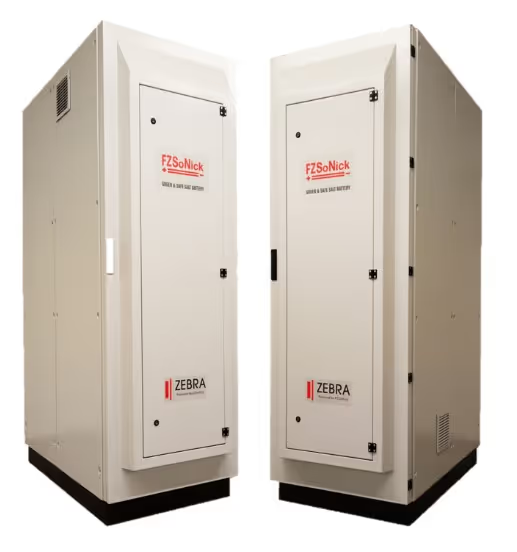
At Elfa, we have a promising alternative to traditional saltwater batteries. A variant with several advantages that are definitely worth considering. This alternative is the Swiss sodium-nickel battery FZSONICK.
This type of FZSONICK battery is also known as a Na-NiCl2 battery or a Zebra battery. Compared to saltwater batteries, sodium-nickel batteries have a higher energy density, allowing them to store more energy in a smaller format. In addition, they offer fast loading times, which is useful in situations where rapid energy uptake is required.
Another advantage of FZSONICK batteries is their long life. They can withstand a large number of charge-discharge cycles, giving them a sustainable and cost-effective be the solution. In addition, they perform well at high temperatures, making them suitable for applications where heat can be a factor.
Safety is also an important aspect of FZSONICK batteries. Like saltwater batteries, FZSONICK systems are extremely safe in use. They are completely free from the risks of fire, explosion and the release of harmful gases. This makes the FZSONICK sodium-nickel battery ideal for companies that value the highest standards of safety and reliability.
Although saltwater batteries have the appropriate properties for large-scale energy storage, it is important to stay up to date with alternative technologies. Would you like to learn more about this type of battery? Then read our extensive blog about the FZSONICK
Case study: energy storage
Saltwater batteries offer excellent energy storage capabilities. Elfa also has the expertise and experience to support large-scale energy storage projects.
In 2023, Elfa was approached by SPIE, an international multi-technical service provider, to deliver an energy storage system for 85 holiday homes at Roompot Beach Resort Brouwersdam.
Roompot had set an ambitious goal: to achieve a 50% reduction in CO₂ emissions and residual waste. To support this objective, Elfa implemented a modular energy storage system designed to store excess energy from solar panels and manage peak loads.
Despite challenges related to safety, longevity, and maintenance, the system has successfully contributed to the sustainable energy supply of the holiday park in Scharendijke.
Read the full case study for more details and watch the video for additional insights into the project.